Filter
Tutorial
Tutorial
HOW TO Lob Haircut Tutorial: Pleated Long Bob Hairstyle
Looking for a how to lob haircut tutorial? Look no further. This will give you all the details and instruction on how to create a pleated lob haircut which is basically a blunt lob but with a little texture for movement. The tutorial uses scissors as the tool of choice.
Creating pleats in the lob is a great technique for thick hair to create little bit of movement but still give a blunt look. The end result is a beautiful long bob hairstyle.
You can follow along in this how to lob haircut tutorial video taught by Russell Mayes, Director of Content for Jatai, as well as find finer details in the transcript below.
How to Lob Haircut:
Welcome back to Jatai Academy! Today we're going to be doing a long bob, the lob haircut. And we're going to add some pleats or some corrugation to it to help control thickness and to give it a little bit more interest. So let's get started.
So what really differentiates a bob from a lob is obviously the length so a lob technically is going to hit right at the collar bone. If it's above the collar bone but not quite to the top of the ears that's really no man's land.
Because of the way that the shoulders curve, it forces it to flip so it has to be at least to the collar bone so it can kind of cup under. And what will help cup it under especially if you have really thick hair is to add what I'll call pleating to it where we'll take one section and cut it blunt.
The next section we're going to point cut it and get some texture to it. The next section we'll cut blunt and then we'll make each other layer have some texture and have some pleating to it.
And that's going to give you a little bit more control when you're trying to make that hair cup under to keep it from flipping out.
Baseline Blunt Cut
So I've sectioned everything off, natural center part to the crown, crown to the occipital bone, occipital bone to the mastoid right behind the ear. This gives me my foundation line, my base line that everything else is going to be built off of.
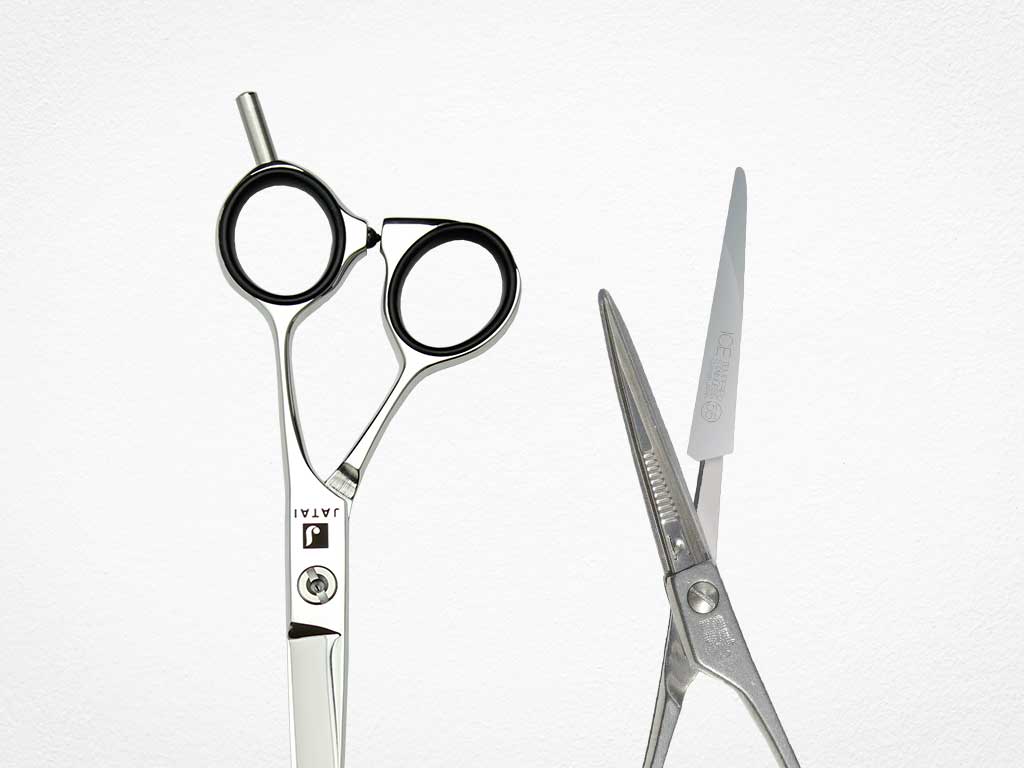
I'm going to start with my Jatai Kyoto Scissors by BMAC. It's the sharpest scissor that I have in my Arsenal it's got a nice uh fat blade on it so it has some weight when I close down and cut so I can cut a thicker section.
And even on smaller sections it'll give me a cleaner line because it's got that weight to really chop that hair off in a nice clean blunt line.
So I'm going to start right in the center. I'm going to comb everything straight down in natural fall. Now since my mannequin head obviously doesn't have any shoulders, I want to pay attention to where I think the shoulders would be and the collar bone would be and I'm going to go about an inch past where my head ends thinking that that's going to be about where a collar bone is going to be on most people.
And I want to hit it right at the collar bone as close as I can. So I'll comb everything down, straight down not flip my fingers, use my ring finger for support, take my scissors, as I close the scissor I'll pull back on the blade and cut that as blunt as possible.
If I feel I need to, I'll go back in, clean that up. Now if I have a human, then what I can do is at this point I can comb it down on the skin and go through and clean up any slight graduation that I have from holding it in my fingers.
Since I don't have that I'm just going to move on. The next section, I'm going to comb back within the boundaries of this hairline so it's going to leave it a little bit longer in the front, but since her head is tilted down that's going to compensate for that.
Comb everything clean nice and through, there's my guide, ring finger to support, cut on the back stroke all the way through. Now I have my lob line starting to go through where I think the collar bone is going to be. Do the same thing on the other side.
Pleating Round 1
That's looking pretty good, pretty even to me. Now I'll take my next section in which I'm going to start my pleating. I'll measure where that head is flat so where I lay the comb against the head, where it touches the head, that's going to determine the width of my section.
And I'm going to follow the same angle of my original parting. Now this brings me to one of the problem areas that I have when I'm trying to pleat or trying to add some texture to inner layers.
If I take my section like I normally would and I comb this down, there's my guide, and I start texturizing it or point cutting it, I'm basically going to point cut my original line and the new section.
So what I want to do is I want to go through and remove the original parting or at least the majority of it, comb this down where I think the other line is.
I'm going to guess at my length and by adding some texture and guessing at my length I will go through and add some deep texture to that section and not worry if it's exactly on top of my previously cut section.
I just want to go through and make sure I get some deep texture to it. After I cut that I can comb the entire section down, see what hangs off and then go through and cut that length off.
Let's go again here on this side. I want to remove my original section, at least the majority of it. I'll take my next section comb that down where I think I ought to be cutting. And then I'll go through, deep cut and pleat that section.
Take my next section, comb that through within the boundaries of my hairline, pleat that through some deep point cuts. What I'm basically trying to do is remove weight and create some movement to it.
After I finish the entire section, I'll comb everything down. Anything that hangs over I'll cut off. If it tends to be a little shorter on those pleated sections that's okay as long as it's not a big gap of being short.
If it's a little longer I can clean that up by going through and cutting my blunt length. So let's do the same on the other side. We're going to...there's my original. My next section hold this straight down in natural fall, there's my previously cut pleated line.
Click subscribe, give us a thumbs up and the notification bell to be notified of future Jatai Academy content.
Cut that down and through. My last piece here, comb within the boundaries. There's my line. Pleat cut that at what I guesstimate the line should be. If it's a little longer when I comb that down, I'll cut those pieces off.
Now we're going to comb everything down. I'll check my...come here... I'll check my length on both sides. That's still looking pretty good. Now I'll move on to my third section.
Blunt Cutting
Third section is going to be the same. I'll lay the comb against the head where it's flat and then I'll use that as my section depth and then bring that all the way around to the side of the head, pin this cleanly out of the way...if I can... if I can get a pin in there. Clip that up there.
We go same thing on the other side now since I pleated the last section. This section is going to be cut blunt so I'm going to follow the same methodology that I have for when I cut everything one length.
I take my section. It's going to be a flat width of section. I'll comb that straight down in natural fall. There's my guide from underneath. I'll use my ring finger to support and cut on the back stroke to make that as blunt as I can.
I will follow that section all the way around cutting everything as blunt as possible. Then just double checking, combing everything as clean as consistent as possible and making sure my line is nice and blunt and even not too much longer in the front not too much shorter in the front. Just kind of even all the way around.
A little longer in the front is okay but not shorter. So now I'm going to do the same thing on the other side. All right, so now we've got that. Let's check and see how off we are. And that's actually not bad that is actually not bad at all. I got...wow I might actually charge you for this haircut. It looks pretty even, looks pretty even.
Pleating Round 2
So now let's move on to our next section which will be another pleated section. Okay we've got our next section and we're beginning to run out of hair but the methodology is going to be exactly the same.
Comb this through where I think the length should be, take my Jatai Kyoto Scissors by BMAC and then go through and deep point cut that whole section to create some pleating through there which will remove some weight and make it easier to move the hair left and right and cup it under.
Remove the previously cut section, comb everything down in its natural fall. I think we're going to be about right there go, through point cut that through, small piece of that as my guide.
Follow us on your favorite social media platform @jataifeather
Comb this down natural fall. There's my previously cut guide, go through point cut deep channel that, small piece as my guide. The last section here, comb through everything straight down natural fall. I see a little bit of my guide from underneath.
Deep channel point cut that. Now I'll just comb everything straight down including the sections underneath and you can see I've got a little bit of length hanging over which is okay.
And I will clean up any of that length that hangs over. I still have my deep channel point cut pleat through there. This is just cleaning up the ends to make sure everything matches at my one length lob length.
I forgot what I was saying there. Looking pretty good. Now we're going to do the same thing on the other side. Okay so when I'm cutting a lob and I'm going to add some pleading to it.
Last Section - Blunt Cutting
I want to start with a blunt line and I want to finish with the blunt line. I want the intersections to be point cut but I want to start and finish with a blunt line. So this is my last section combing everything down in its natural fall and just cutting everything one length and blunt.
Now I know what you're thinking, I know what you're asking. You're going to ask me 'well why not just point cut the whole thing?' If I point cut the whole thing, I don't end up with as blunt of an overall shape and all I want to do is put some invisible pleating in it to allow it to style easier.
I'm not trying to necessarily make it look textured. I want it to look blunt and solid, but I want to be able to add some movement into it by me cutting it internally adding those pleats internally so they're invisible.
Comb everything in its natural fall. Anything that hangs over we will cut off. Comb through. There's my guide length make sure that I on top of my previously cut guide and not cutting it shorter and not cutting it longer but staying exactly...come here... on top of that.
Do the same thing on the other side and then let's see what we got. Let's check and see how perfect it is. Yeah, not bad. I think I've got a little more length on the left side right here in the front, but I'm not going to worry about that right now I'm going to blow it dry and then I'll check it again once everything's blown dry.
Finished Pleated Lob Result
Here's our finished result blown dry, smoothed out. We've got a nice really really solid one length shape but it has a little bit more movement and flexibility with how we can control whether it flips under so it will give a more refined shape to it.
So it won't be quite so broom like and stiff because that pleating gives you that breathability internally without beveling the shape.
If we were to go through and point cut the whole thing it would bevel this shape and make it look slightly layered and graduated on the bottom and you would see that. But now since we've done every other and we started with blunt and ended with blunt, it's still going to have that blunt un-graduated un-layered shape.
So I think we did pretty good. I think the length is pretty good. Let's get some hair out of your face girl.
Check out the Jatai Academy. There's all kinds of great information on there to make you a better hair stylist and barber. Let us know what you'd like to see in the future and thank you so much for watching our video. We'll see you next time.
Tutorial
Tutorial
Octopus Haircut vs. Wolf Cut - Octopus Hair Tutorial
There are so many different hair trends with various names. Two popular hairstyles are the wolf cut and octopus cut. An octopus haircut vs. wolf cut have several differences. A wolf cut is layered more around the face while an octopus has layers all around.
Octopus styles have a puff of volume in the crown and less weight in the lengths whereas the wolf cut has a more solid perimeter shape. Both are easy to style and wear whether it be keeping it straight or putting in loose curls or waves.
It can be done on curly hair, medium to longer hair and the styling requires little product. They also look good with any hair color. These are 2 beauty trend styles that are classic and timeless.
In this article we will discuss how to do an octopus haircut. You can watch the video below and follow along with the transcript. If you'd like to how to do a wolf haircut, see the very bottom of the article for a link to a wolf cut tutorial.
Octopus Haircut Tutorial:
Welcome to the Jatai Academy. Today we're going to be covering how to do an octopus layered haircut which is basically a layered haircut with a little bubble on top but we're going to do it a little different than last time. This time it's going to be much more textured. It's going to have a lot more separation to it and a little bit more fullness. So let's get started.
Establishing the Perimeter and Sectioning
Before I go through and section off everything for my layering I want to go through and make sure that I have the perimeter length at the length that I want. So I'm going to start by taking a center section straight down the back of the head and while I'm not worried that this line is perfectly crisp and solid and straight, I do want a crisp point cut to it. I want a real deep crisp point cut to force it to separate into pieces stronger.
So I'm going to use my Kyoto Scissors from Jatai. These are the sharpest scissors that I have. It's got a nice blade so when I go through and do a deep point cut on it because it's sharp I'm going to get a really nice crisp line to it. Take everything down. Any part that hangs off that looks kind of gnarly we're going to take off and I want a real crisp point cut into this length.
I'm going to show you how I've sectioned out the head. I've taken a natural or center part straight back to the quarter part, quarter part straight down to the center of the spine. From the top of the head I go to the top of the ear. That's going to be my quarter part. So I have front and back.
Now in the back I'm going to separate from the drop crown which is the section between the top of the head and the occipital bone. It's right there in the middle. It's also the top of the parietal ridge on the side. So it's going to go straight across. This is going to be my shortest part and then everything else is going to blend in from that.
Top Section
I'm going to go through take a center section. I'm going to pull this section straight up and I want to kind of cut this horizontally across the top. So I'm going to pull this straight up and across, figure out where my shortest length is going to be, point cut that straight across the top.
So now I'm going to take my next section. It's going to be parallel to this center section. I'm going to pull this guide right into my second section. So I have the first section and the second section. I'm going to comb those two together and in the center of that section, using my center as the guide, I'm going to cut that straight across.
From here I'm going to remove the center section. Now I have section number two. We're going to go through take section number three which is parallel to section number two. I'm going to comb those two into the center of both of those two sections, hold straight up towards the ceiling, follow my center guide or my previously cut guide, cut that straight across the top.
After I've removed section number two at section number three I'm just going to comb everything else straight up into section number three, go through cut that across. I have the center section on the first side.
Now I'm going to go through and take a parallel section to that on the second side and repeat the same steps I did on the first side where I'm combing everything into the previously cut section and cutting that straight across.
Give us a thumbs up, click subscribe and the notification bell to be notified of future Jatai Academy content.
Bottom Section
Okay so we got our top done. Now let's move into the bottom. We're going to take a center section all the way down. So now what I want to do is the first section I held that straight up.
Now from here I'm going to hold this straight up, but I'm also going to angle my fingers so I can go from this short piece to this long piece down here in the bottom. I've already cut this so I'm going to get that out of the way. Small piece. I'm going to pull that straight up, angle my fingers, continue my point cut as I go from short to long.
Take a small piece as my guide. We're going to take the rest of this section. Again, pull straight up, angle my fingers all the way down to my length. Now from here I'm going to pivot as I go around. Before I was doing parallel. Now I'm going to pivot. Remove the top. I've already cut.
Then take a small section here, comb everything clean from the root all the way straight up. There's my guide. I'm working my angle, cutting that down and through. Take the rest of the section. If I need to I'll break it down into smaller sections. Comb that up. I see my guide from underneath. Cut that down and through.
Good. Now we're going to remove my center section and add my next pivot, just following the same pattern that I was doing before, combing everything straight up to the ceiling. There's my guide from underneath, follow that through, get the previously cut hair out of the way up and out. Come on there we go.
Next section up and out. Now we're going to take our last section, remove the top. I've already cut that. Before I was walking the guide around but once I reach the corner of the hairline I'm going to pull everything in back to that corner the hairline into this previously cut section. Up and out.
There's my guide. Cut that through. Remove the previously cut section pulling this down and through up. There's my length on the bottom. I'm going to go through.
Cut that down and through. Alright let's check ourselves out here and see how we're looking. We've got a nice short amount of layering on the top. Because this was layered at a lower elevation because it was layered at 90 it's going to have more weight than the hair underneath of it which was actually held at a higher elevation going all the way up. It was probably held at about a 180.
So because the top is going to have more weight it's actually going to have more volume because it's going to be more solid. The underneath because it's been over layered it's going to have a tendrilly effect. So you're going to have this weight build up here in the crown and then a tendrilly effect underneath. So now let's go through and do the same thing on the other side.
Sides
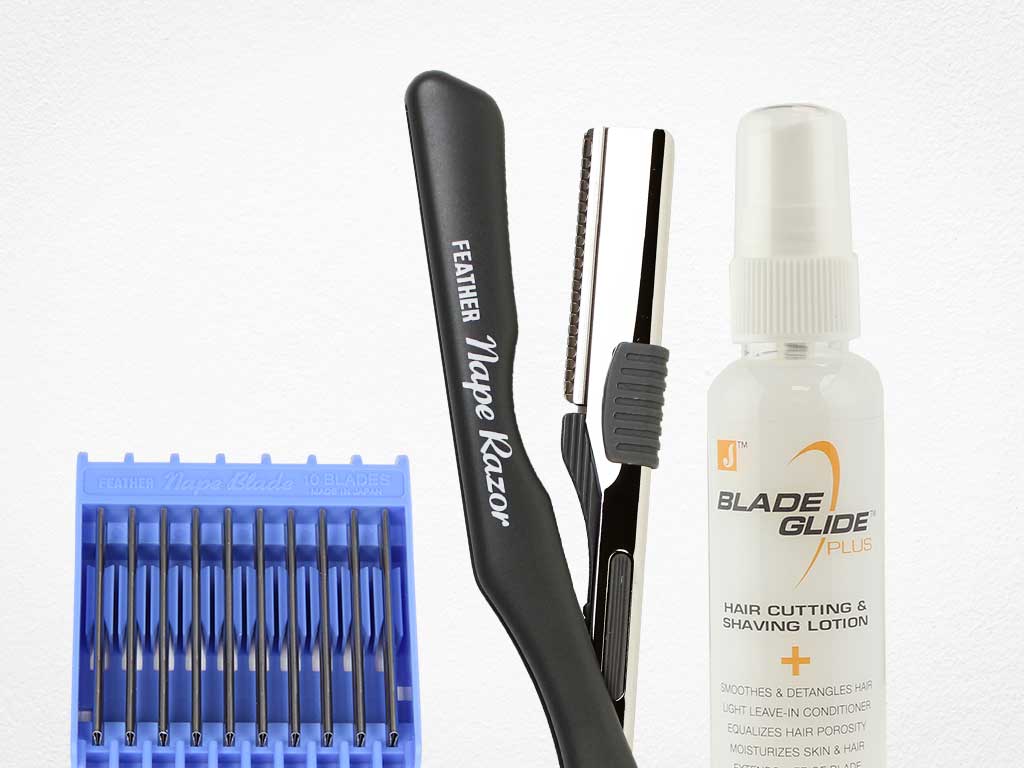
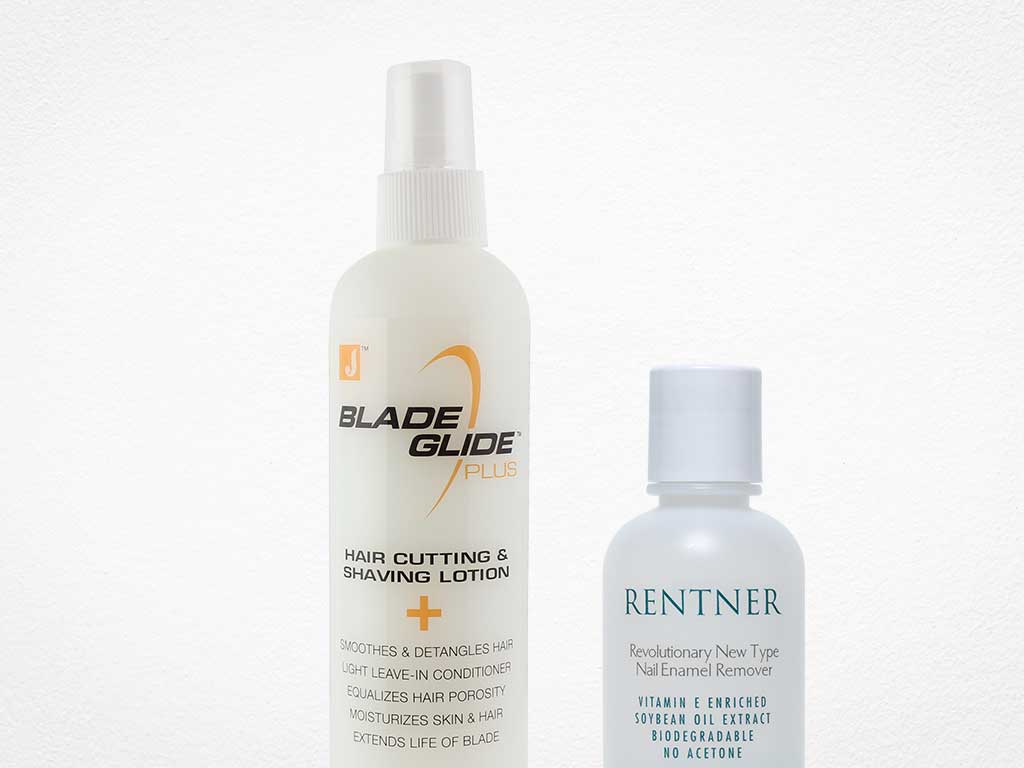
Now that I finished my layering in the back I'm going to move into the sides and I want to make sure that I keep everything an even wetness. And I want to make sure that I can keep the cuticle as compact as possible. So I'm using Jatai Blade Glide. This will help keep everything crisp and compact and also an even moisture content throughout.
I'm going to take a section from behind my quarter part. That's going to be the guide for the layering as I work around the front. I'm now going to go through and take a parallel section to my quarter part, my quarter part straight up and down. So I want to make sure that this section is straight up and down.
So now I have my parallel section plus a guide from the back half of the head. I'm going to go through pull this up and now from here I have to go to this length on the side so we're going to extremely angle that layering around the front half of the head. We're going to blend it through at the very top. Make sure that this length right here blends with the length behind it and then from there I'm creating a completely new guide.
Comb everything straight up going from short to long as I'm working that through all the way down to my perimeter length pulling everything straight up. There's my perimeter length cutting that down and through.
It's more important when I'm doing extreme angles of layering like this. It's far more important that it blends top to bottom meaning from here to here then it does front to back. So we're not worrying if it blends front to back. We're only worrying if it blends top to bottom.
My next section should be very little hair especially because of our receding hairline. I'm going to pull this straight back into the previously cut section. There is my guide going short to long pulling straight up towards the ceiling and making sure that blends top to bottom.
Pulling this straight back to my quarter part, pulling everything back to the quarter part. There's my guide from underneath cutting that through. That's going to do very nicely. So now let's go through and do the same thing on the other side. Okay so we've got our layering done. So now let's go through and just make sure that all of our layering around the front has a nice smooth blend to it.
Blending and Weight Removal
So I'm going to go through take a center section lay the comb flat against the head where it leaves the head straight down to the top of the ear. Going to do this on both sides. From here I'm going to take a little pie section right in the middle.
We're going to comb it forward off peak curvature of the head and then we're going to go through deep point cut that so I have a nice crisp point cut because I'm using my sharp Kyoto Scissors. Comb that out of the way.
Going to pull this forward as well and just make sure that we have some nice crispy point cuts around this front to help with separation and I'm only going to do it to this section right here.
Same thing on the other side. Oh we can already see how that's starting to flick better on its own. Now let's blow it dry see how we look and see where we need to add some texture to it. So what I'm going to do is I'm going to comb out and right in the midsection I'm going to take my Tokyo Thinning Scissors and go and hit just right in the middle.
Pull that out so that way I can thin some hair and create a little bit more movement just in the middle. And I'm only going to do that in the thickest areas where I feel like it's not really flowing that well. So I'll comb this out. I'll say a little there a little there. We're going to pull that out. Go up. You can see it right through there.
Boom boom boom and I think that that's going to flow a lot better once we get some of that internal thickness out of it. Comb out. We can see not much there, a little bit right there. Comb up. That's looking pretty good.
Give us a follow on your favorite social media platform @jataifeather
There we're going to pull some of that, take that, pull that out. This is purely subjective and visual where you feel like the hair needs a little extra removal and I'm just going to continue doing this throughout the rest of the head. Here's our end result and I think that uh we're looking pretty good. We got a nice little bit of movement around the front.
We've got a nice solid crown with some good volume because this is nice and short but it's still a solid shape through here in the crown which ends up going really soft and tendrilly and really layered underneath.
And I think that's what really gives this shape you know the the octopus you know vibe is where it's solid and full here and tendrilly and long and soft underneath. So I think it looks pretty good. I think it looks nice and you look fabulous my dear.
Also check out the Jatai Academy. There's all kinds of fantastic content on there that will make you a better hair stylist and barber. Let us know what you'd like to see in the future and we will see you next time. Thank you so much for watching.
Final Look Haircut Octopus Style
To see how to do a wolf cut, watch this video Soft Wolf Razor Haircut.
Tutorial
Tutorial
A Layered V Cut Tutorial using a Feather Plier Razor
In this video tutorial, Russell guides you through the process of achieving a medium layered V cut tutorial with simplicity and clarity. This is a straightforward demonstration of the steps involved in creating a subtle yet stylish V-shaped hair cut.
Follow along as Russell shares practical tips and techniques, making it easy for you to replicate this haircut in the salon and on your favorite clients. Learn how to use the Feather Plier Razor to cut the hair and maintain modern softness and shape. Jatai Blade Glide is used to keep the hair smooth during the cutting process.
V shapes and V layering is discussed where V layering is when hair is shorter in the front and sides and longer on the back. A V shaped cut is shaped so that the ends angle down into a perfect V in the back.
This V line haircut is a popular hairstyle with long hair, especially when the hair give soft waves or a beachy hair style. This razor cut hair style looks great on all hair types from thick hair, thin hair, straight hair and wavy hair. But doesn't work as well on hair with lots of curls. A Curly hair V cut would make the hair get big really quick from short to long.
A V shaped haircut also looks good on medium to long length hair. In fact the longer the hair, the better. A Long layered V cut is aesthetically pleasing to the visual eye. The V layered haircut compliments the face shape as the layers in front frame the face. It can work with any hair color such as chocolate brown, hair with highlights and blonde hair.
V shaped hair styles have a more dramatic shape. You can see various versions and hair ideas just by scrolling on Instagram or Pinterest. A V shape haircut is a beautiful and feminine cut hairstyle that is versatile and is low maintenance so the client won't need frequent regular trims. Watch this layered V cut tutorial and follow along with the transcript.
Layered V Cut Tutorial:
Welcome to the Jatai Academy. Today we're going to be doing a study on V-shapes and V-layering. Now V-layering is basically where the hair is shorter in the front and on the sides and longer in the back. Now it's not a mullet but it has that that V angle and shape in the back that's very very popular especially on long hair where you put that little bit of beach wave into it. It's very pretty. So let's get started.
Sectioning Your V Shaped Haircut
So to get started I'm going to separate the top of the head from the bottom of the head and I'm going to take the recession all the way straight back to the crown and then I'm going to do the same thing on the other side. See if that matches. That looks pretty good. Match that all the way around.
So we're going to separate the top from the bottom. When I go through and do this layering I need to be conscientious of how my overall length is going to affect my layering.
So if this is my longest point in the back which I want to keep that long because I want it to be longer in the middle of the back, I can pull that forward and see okay that's the length. I pull this shortest piece up here. I know I can't go any shorter than about that right there while still maintaining this overall length in the back.
The next thing I want to take into consideration is the angle of my parting up front. If I angle here and I pull my section parallel, because I'm holding it at a graduated angle it's going to be heavier around the front and it's going to shift back. So do I want it heavy or do I want it light?
Using the Feather Plier Razor to Create a V Shaped Hair Cut
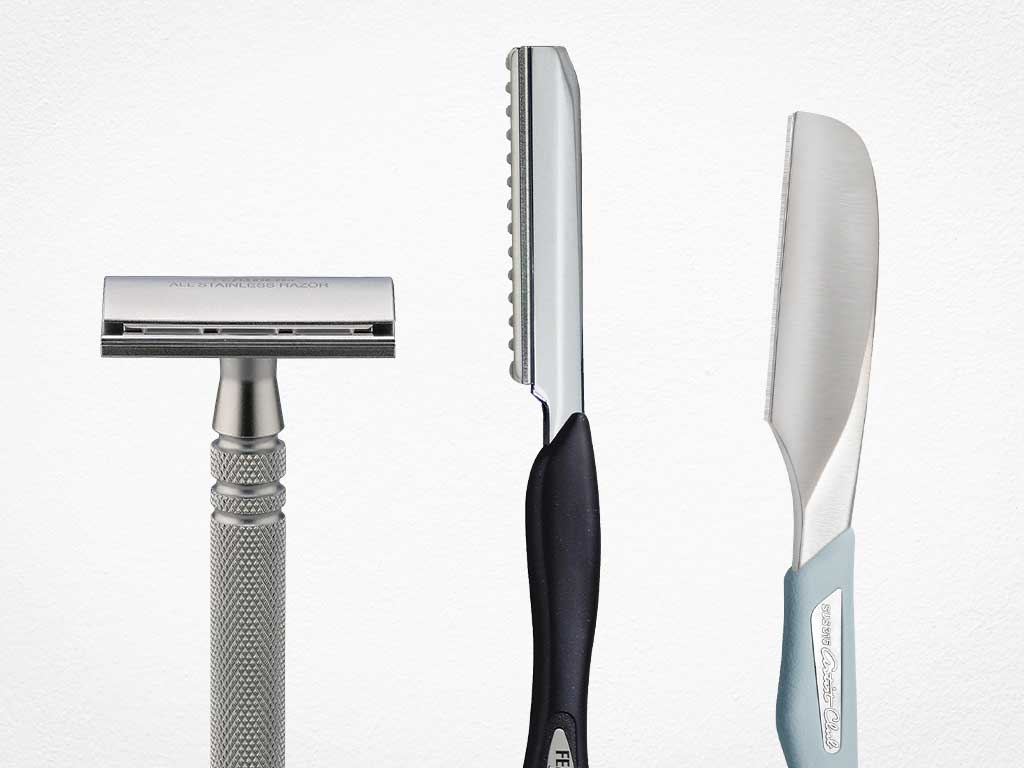
Take my vertical section. I'm going to pull that forward. I'm going to open my Feather Plier Razor. This gives me the most control and the cleanest cut line of all the razors that I have in my arsenal. I'm going to pull this forward. I'm going to determine my length which is about right there and now I'm going to go through and take a nice broad razor stroke parallel to my parting.
From here close the blade when I section so I don't have to worry about cutting myself. I'll take a parallel section straight back. Pull this forward. Alter the curvature of the head. That's the elevation that I'm going to hold this section.
Open my blade. There's my guide. Cut that down and through. Now we're going to go all the way down to the corner of the hairline. I'm going to remove my first section. So now I only have my second and my third. At this section I'm going to hold it at that elevation.
Continue to pull forward. There's my guide. Now I'm going to remove my second section. Pin that out of the way. The next section parallel to my previous and I'm just going to continue to work this all the way back into the center of the head.
There's my guide and as I get closer to the back I should have less hair to cut. Take my next section straight down the center of the back of the head.
Again this is the elevation that I'm holding it. Open that blade. There's my guide. Very little to cut. I finish this side. I'm going to go through and do the exact same thing on the other side.
See if our lengths are the same and they look pretty good. And you can certainly see that this shape is already developing into a V. So the longer the hair is the better that I think that this shape works. The thicker the hair is the more you can take out in a lighter in an area you can get it without it feeling real mullety.
Address the Top for a V Shaped Layered Haircut
So we're going to go through, take a section straight across the top. Pin all this out of the way. I'm going to go through and use a little bit of Jatai Blade Glide just to make sure that the moisture is consistent and also to make the blade glide through the hair easier and cut more consistently.
I'm going to tilt the head down just a little bit so you can see where I'm coming from. There's my guide on the side and we're going to go through cut this straight across to my guide from the other side.
My next section is going to be parallel and I'm basically going to do the same thing I did to the sides just going across the top. Now the reason I separated the top out is because when I start going off the curvature of the head it starts getting elevated a lot more than the sides so it's easier for me to keep control of it by taking the section separate.
Make sure I'm going off the curvature of the head. There's my guide. We're going to go through cut that straightacross.
Next sections parallel to the previous sections as I continue to work that back. Now here I'm going to tilt her head down a little bit and this is the elevation that I'm going off of. Now as I get to the back, you'll see that start to elevate quite quickly.
Go through. There's my guide. A nice broad stroke. Next section and only one after that, lowering the head again. This is the elevation that we're going off of. Get my razor right. Get my section right. There's my elevation. There's my guide.
Go through cut that through and again as I get to the back I should have less and less hair to cut. Last section this is where I'm going to elevate it all the way up. Proper elevation. There's my guide. Go through, cut that length off.
Now by going through and cutting with a razor that's going to keep the ends very light and airy and I think very very consistent and I think very pretty for this type of haircut. Not much on this side. Perfect.
Styling the V Shape Hair Cut
We've got, we got our shape cut into it. I think it looks very nice. It flows really well. We've got this kind of bohemian chic going on with a little bit of uh rocker thrown in. So let's blow it dry. Take a look at it.
We finished our blow dry. You can certainly see the shape developed pretty well. We've got this longer center of the back with it fuller through the back of the head where we left most of the length. As we layered it more around the front, it transitions very well into the back and we have this very you know bohemian 70s inspired kind of shape and that's just the way we blew it dry. V cut hairstyles tends to work well on all types of hair, thicker, thinner, wavier, maybe not curly hair. Super curly hair because it can get real big real quick going from this short to long, but it works really well on most hair. The longer that it is I think the better that this shape works and the better it looks especially if you're going for one of those balayage beach wave type of shapes. A long V haircut is preferable but I think this V hairstyle works really really well. So let us know what you'd like to see in the future. Please check out the Jatai Academy. There's all kinds of great information on there that will make you a better hairstylist and barber and we really appreciate you watching. We'll see you next time.
Final Layered V Cut with Layers
Here's the final V Haircut with Layers look. As you can see the hair in V shape in the back is seamless.
Tutorial
Tutorial
How to do the Butterfly Haircut with Bangs on Long Hair Tutorial
In this article we're going to be doing a long length butterfly haircut with curtain bangs using the Feather Styling Razor. Follow along with the video. The video has been transcribed below.
How to Do the Butterfly Haircut Tutorial Video:
Channel Cutting
So this is how to do the butterfly haircut. We're going to start in the middle with a section straight down the middle all the way back center back of the head. We're going to go from occipital to mastoid. That's going to separate all the flat area. And then since that area is a little bit thick I'm going to take a subsection of that and just give me enough hair
I can control using my Feather Styling Razor and the special pink edition. We're going to comb everything down and I'm going to go through and channel cut each one of these little sections so that I can get a piecey separation but still maintain all my length.
So my razor stroke is probably about a 2 inch stroke but by going through and putting the tip of the blade in and channel cutting it, I'm not only texturizing the ends but I'm also cutting the length at the same time.
Now here I'm going to go through and continue the same methodology, take my next flat section, comb that down find my guide, go through with my razor, channel cut that into the desired length that I want so I can maintain separation on the bottom but still keep a very solid shape.
I can certainly go through and channel deeper if I want more separation, more thinning. But I just want this texture to be on the ends so I'm going to go through and keep it just on the ends concentrated to where I want it to be and just follow the same guide that I had before and try to keep the same razor stroke of about 2 - 2.5 inches.
Here I'll comb everything down make sure I don't have any long little stragglers and now I'll just continue this same methodology all the way up the head until I run out of hair. Same thing just combing everything down using my guide and continuing until I run out of hair, until I cut everything one length in the back.
Butterfly Wing Bangs
Now the whole idea behind the butterfly cut is that I keep my layering around the face and the back of it doesn't have a whole lot of layering. It's mostly concentrated around the face with beautiful face framing layers.
So from here I'm taking from the first bump of the head where the bangs are to the high point of the ear. I'm going to pull a little section out in the center. I'm going to pull that forward and right about the tip of her nose I'm going to go through and channel cut this to make sure I get the right length that I want and also to get the separation that I want.
So I want separation and pieciness and light and airiness on the ends but I still want a solid shape internal. So I'm going to use my little piece as my guide that I did right in the middle.
Now I'm going to take a broad razor stroke and go through and cut this entire length off. Now the difference between me channel cutting and just razoring the whole length of it off is by razoring the whole length of it off I'm actually going to get a lighter airier separation on the ends but I'm going to maintain a more solid piece.
Whereas if I channel cut it, I'll force that to separate into pieces that are much more defined so I'm pulling everything forward following parallel to my main parting that I took and cutting my length that I want.
I'm going to do the same thing on the other side. Take a nice broad razor stroke cut all that length off but I still want to maintain all of my length. So by razoring this front off, I'll show you how I create shortness in the front and then build that up into a lot of length in the back.
So once I get everything fit in around the face look I want by pulling it forward I'm actually going to feather everything back. And this cut is very reminiscent of a 70's you know Farrah Fawcett kind of feather cut.
Addressing the Back Sections
After I get everything fit in like I want around the front, I'll continue my sectioning towards the back of the head. Here I'm taking from the high point of the head right to the mastoid. I'll find my guide underneath and then I'll continue that same broad razor stroke all the way down.
Now here where I started in the center I blended that with my guide underneath. As I continue to work down I will increase the length so it only blends at the top of the head, but as I get closer to the bottom of the head it gets longer and longer and longer. So I'm actually step layering it going from the front to the back but keeping it blended right there at the top in the bang section.
Checking my overall length and shape and seeing how that's fitting in around the front and making sure that looks good before I continue on to the opposite side. And I'll do the same thing.
It's going to blend right at the top center where her bangs are and it's going to gradually increase in length as I go down the head and get into my perimeter length. So by keeping it short and layered around the front and then disconnecting it as I go towards the back I can still get a blend because it is blending from the top to the bottom.
Checking the lengths there making sure they're looking pretty good. Got a little bit right there on the left side making sure that that blends in. And taking my time because this is important that I get the textures right and the shape even around the front because when I feather it back I want it to be as symmetrical as possible on each side.
Now since it's not a real precise haircut on the shape that I'm cutting, it needs to be precise and how it fits the head. So as I continue to work back, the sections blend at the top and then gradually step disconnect as it it goes towards the bottom but I want to make sure that I'm keeping all of my sections very very symmetrical and the same on both sides.
I don't want one side to get layered more than the other. I already have an off center part so I have to deal with the weight distribution but by keeping my partings the same on both sides I can maintain a symmetry in the haircut. After I finish that I'm going to go right back to the center of the back of the head pull everything forward and down.
Now you notice the further in the back I go, the more I angle that section down. The more that I angle it down the more weight that I'm going to create. The more I pull it forward the more feathering back that I'm going to create.
So after I go through and cut the entire side I'm going to shake it out and check it. It's going to be layered a lot more around the face. It's going to be lighter and a lot heavier in the back. But I want to check and make sure that my flow is proper. It's flowing out of the face and giving me that kind of feathery butterfly wing kind of look.
Now this one's going to be a little shorter because I've cut a real short little bang right in the center that I'm using as my guide. You could certainly do this a lot longer like Farrah had it and have that flip more around the face but on this one with some bangs it gives it a little bit more neutrality and interest around the eyes.
So I'm going to continue the same thing on the opposite side here continuing to pull everything forward and down and making sure that that blends in through with the front. Making sure I'm taking my time and that my partings are symmetrical on each side.
Continue to pull if nothing cuts. If nothing reaches, nothing gets cut. I'm going to pull and check following through with my razor. Now as I go through and razor, I'll start at the base of the blade back closest towards my hand and then as I razor motion, I'll go more toward the tip.
I don't want to just razor with just the tip. I want a razor using the entire length of the blade so that I can use the whole blade and it doesn't dull out just the tip. Check this side make sure everything's looking pretty good, shaking everything out and seeing how it looks.
And I I think that this is looking pretty good. Real solid on the bottom but very light and airy around the face. So let's go through and put a little texture spray into it and go through and blow it dry.
Blowdrying
I'm going to blow dry everything back off the face and then we're going to put a little bit of curl in it just to enhance it a little bit. You can certainly see that we got a lot of layering around the front.
It's feathering back off the face. We can put more curl in there if we want, less curl if we want. From beginning to end, this is how to do the butterfly haircut. We hope you enjoyed this demonstration.
A few notes about butterfly haircuts in general. Butterfly haircuts work best on medium to thick hair. They don't work as well on thin hair. It can work on any hair color from blonde highlights to brunette to colored hair.
The butterfly cut creates wispy layers in the front for extra volume. It's the short layers in the front that gives the butterfly haircut it's name. It's a lovely style that can work on medium to long hair.
You can do a short butterfly haircut with curtain bangs but the hair should be at least to the collar bone. And while this was a tutorial on a butterfly haircut with curtain bangs straight hair, it can also be done with wavy or curlier hair types.
The Final Butterfly Haircut Look
Follow along on how to do the butterfly haircut in the video above or watch it at Jatai Academy's Education Connect portal. There's a lot of great information on there that'll make you a better hairdresser.
Tutorial
Showing 16/16