Filter and sort

18 products

0 selected
$

0

$

41.25

0 selected
0 selected
0 selected
0 selected
0 selected
0 selected

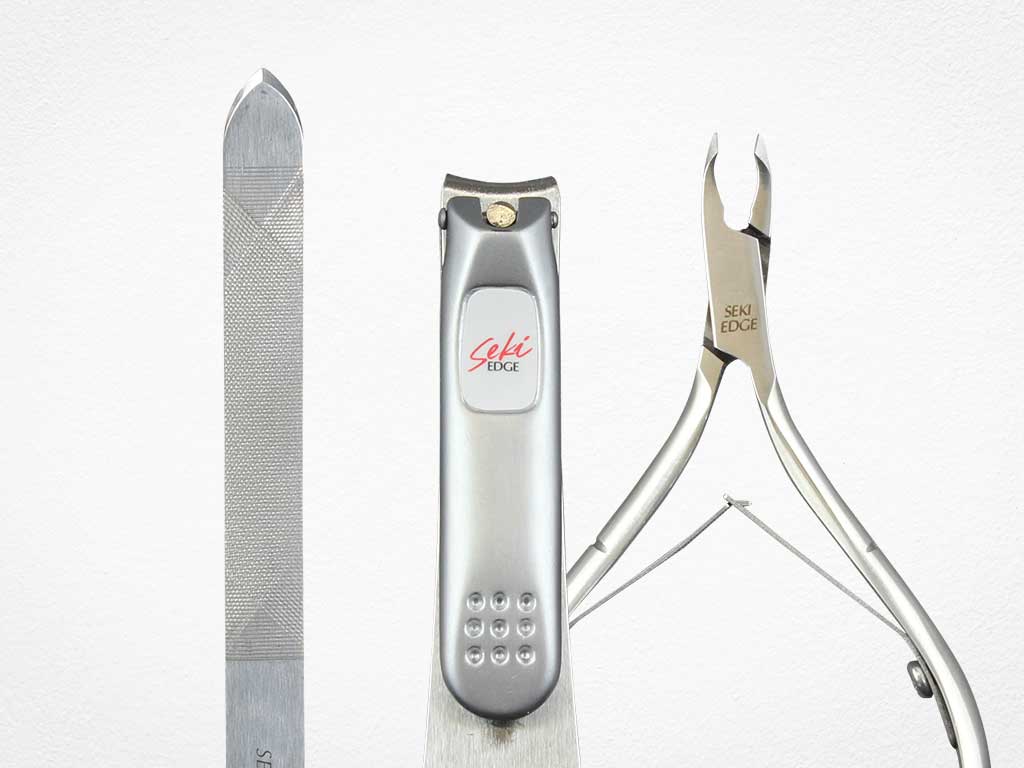
Seki Edge Stainless Steel Nail Clipper SS-112

Seki Edge Stainless Steel Nail Clipper (SS-112)

$25.00 $18.75
Seki Edge Premium Fingernail Clippers (SS-113)

Seki Edge Premium Fingernail Clipper (SS-113)

$21.00 $15.75
Seki Edge 1-4 Jaw Cuticle Nipper (SS-306)

Seki Edge 1/4 Jaw Cuticle Nipper (SS-306)

$30.00 $22.50
Seki Edge Nail File with Pusher (SS-402)

Seki Edge Nail File with Pusher (SS-402)

$9.00 $6.75
Seki Edge Large Rounded Nail File (SS-405)

Seki Edge Rounded Nail File (SS-405)

$12.00 $9.00
Seki Edge Long Toenail File (SS-401)

Seki Edge Long Toenail File (SS-401)

$10.00 $7.50
Seki Edge Cuticle Pusher (SS-303)

Seki Edge Cuticle Pusher (SS-303)

$8.00 $6.00
Seki Edge Flat Slant Tip Cuticle Nipper (SS-301)

Seki Edge Flat Slant Cuticle Nipper (SS-301)

$21.00 $15.75
Seki Edge Acrylic Nail Scissors (SS-201)

Seki Edge Acrylic Nail Scissors (SS-201)

$19.00 $14.25
Seki Edge Professional Nail Nipper (SS-202)

Seki Edge Professional Nail Nipper (SS-202)

$32.00 $24.00
Seki Edge Nail Nipper with Shield (SS-204)

Seki Edge Nail Nipper with Shield (SS-204)

$55.00 $41.25

Showing 16/18

RELATED ARTICLES

The Best Fingernail and Toenail Clippers on the Market

The Best Fingernail and Toenail Clippers on the Market

by JATAI, 15 Nov 2021
One usually doesn't think about nail clippers too often, but they sure come to mind when your nail tears or if your nails are getting too long and need a trim. Having a good quality nail clipper can surprisingly give a certain satisfaction you wouldn't expect. It's easy to pass off a nail clipper as just a tool you need to trim your nails, but have you ever used a nail clipper that delivered a subpar experience? For example, have you ever tried to use a nail clipper that required a lot of pressure to cut through the nail or that left jagged nails? It's not an uncommon occurrence. For many people these are their biggest gripes. And who wants to deal with frustrating and unpleasant experiences. Even the smallest of tasks (such as clipping your nails) shouldn't give you a headache or another thing to be annoyed with. Nail clipping is something one does pretty frequently so it's important that whatever nail clipper you're using will stand the test of time. The good news is there are some high-quality fingernail and toenail clippers that can deliver sharp, clean cuts with minimal pressure. While having an awesome nail cutting experience is not on the top of everyone's list, it is a small task that can be made much more pleasant with superior tools. Introducing Seki Edge nail clippers! These are high quality Japanese nail clippers forged with Japanese stainless steel, manufactured and hand-finished by craftsman. What's really cool is that the makers of Seki Edge, Green Bell, are descendants of samurai sword makers who merge traditional samurai sword making techniques with modern ones. As you can imagine, these nail clippers have sharp blades. Imagine a samurai sword cutting your nails?! That's pretty insane. Made in Japan, they are quality tested and go through many steps to achieve this perfection. With tools that are sharp like samurai swords, you're sure to get an awesome experience. When cutting your nails, it's important to use the proper nail cutter for the type of nail you are cutting. Fingernail clippers are small overall. Since fingernails are generally smaller than toenails, they are made to more easily cut around the fingernails with ease and control. In fact, if your toenails are small too, you can use fingernail clippers to cut your toenails.   THE DIFFERENT SEKI EDGE NAIL TOOLS Fingernail Clippers Fingernail clippers can be useful for cutting children's nails (both fingernails and toes) as well as softer, brittle nails. For less pressure and for smaller nails, use a fingernail clipper. Seki Edge carries a variety of fingernail clippers. Some have special features such as a built-in nail file or a nail catcher to catch nail clippings.  The Seki Edge Stainless Steel Fingernail Clipper SS-106 is the most popular fingernail clipper in the line. It's sleek, sophisticated and works like a charm. If you like a fingernail clipper with all the features, the Deluxe Fingernail Clipper SS-101 has all the bells and whistles you need. It has a built-in nail catcher and nail file. So this all-in-one Japanese nail cutter is economical and provides a lot of value.   Nail Scissors You can also use a nail scissor, but these are less common. Nail scissors are used if you want more control or if you are trying to shape your nails a certain way.   Toenail Clippers When it comes to cutting toenails, a heavy duty toenail clipper is best. Since toenails are often much thicker and wider than fingernails, a stronger and larger nail clipper may be needed. Toenail clippers feature larger, wider jaws and are overall larger than fingernail clippers. The Seki Edge Stainless Steel Toenail Clipper SS-107 is the most popular Seki Edge toenail clipper and can generally do the job. Another nail clipper that is on the rise is the Seki Edge Stainless Steel Nail Clipper SS-112. It's gained massive popularity due to its fantastic cutting ability. It also has a built-in nail file on the top of the lever. It's heavy and delivers a smooth clean cut.   Nail Nippers A thick nail can be addressed by either a heavy duty nail clipper or a nail nipper. Nail nippers have very strong curved blades, sharp cutting edges and are especially useful for very thick nails. While toenail clippers for thick nails are available, sometimes they are just not strong enough to cut through the thickest of nails. With a nail nipper you can steer your cuts for more cutting control and they have very powerful jaws that cut the nail from the side as opposed to the top and bottom. This makes cutting a very thick nail much easier. For special circumstances such as an ingrown toenail, use a nail clipper with a straight edge or an ingrown nail nipper. Ingrown nails should be cut straight across to prevent the nail from growing into the corners of the skin. If the ingrown nail is also very thick, try the Seki Edge Ingrown Nail Nipper. It's a unique nail nipper where the jaws curve outward so that you don't cut into the nail. Instead, it cuts away from the nail helping you cut straight across.   CONCLUSION Each Seki Edge nail clipper gives a precise cut. They have a sharp curved blade on the top and bottom that come perfectly together to create clean cuts. If you're looking to have nicely trimmed toenails or fingernails, these nail clippers are the best place to start. You won't go wrong with a Japanese nail clipper by Seki Edge. In fact, it will be the only one you'll need. While the Seki Edge line carry several different nail clippers, it is a full personal care line with other tools such as nail nippers, cuticle nippers, grooming kits, eyelash curlers, tweezers and more. To complement the nail clippers, perhaps pair them with a nail file or cuticle nippers. Even if you get your nails done by your favorite nail tech, you can still do some maintenance at home such as trimming hangnails or filing down chipped nails. And if you're a DIYer then these are the best manicure investments you can make. If you want a set that includes a variety of manicure tools, a nail grooming kit can be a good choice. From two to nine pieces, Seki Edge grooming kits have a selection of tools important for any manicure. Most of them include a Seki Edge nail clipper. There have been many satisfied customers who swear by Seki Edge nail clippers. They are ranked very high on other popular websites and review sites. And if you're still not sure if these nail clippers are for you, there are extensive reviews on YouTube about them! That's right...the social proof on these clippers is plentiful. You have found the best fingernail and toenail clippers on the market here. Give your nails the pampering and TLC they deserve and feel the edge with Seki Edge.   Product, Nail Clippers
Understanding the Allure of Japanese Nail Care Tools

Understanding the Allure of Japanese Nail Care Tools

by JATAI, 15 Nov 2023
When it comes to achieving beautifully manicured nails, Japanese nail care tools are renowned for their precision, craftsmanship and attention to detail. With a rich tradition of nail art and an emphasis on nail health, Japan has become a global hub for innovative and effective tools that enable individuals to achieve salon-worthy nails in the comfort of their own homes. Let's explore the allure of Japanese nail care tools and how they can help you achieve perfectly polished nails. Why Japanese Nail Care Tools? Embraces Precision: Japanese nail care tools are designed with meticulous attention to detail. From nail clippers and files to cuticle pushers and nail nippers, these tools are crafted with high-quality materials and precise engineering. The sharp blades and ergonomic designs allow for precise and effortless nail shaping, ensuring a clean and professional finish. Japanese beauty tools are thoroughly tested for quality control to ensure they deliver excellent results.   Nail Art Innovation: Japan is renowned for its intricate and creative nail art designs. From delicate floral patterns to eye-catching geometric shapes, Japanese nail art tools have played a significant role in enabling nail artists to create stunning and intricate designs. Nail art brushes, dotting tools, and stamping plates are among the popular tools that offer unparalleled precision and control. These tools allow individuals to explore their creativity and elevate their nail art game.   Focus on Nail Health: Japanese nail care tools not only focus on aesthetics but also prioritize nail health. Cuticle nippers and pushers are designed to gently remove excess cuticles without damaging the nail bed. Nail buffers and polish correctors help maintain the integrity of the nail surface, ensuring healthier and stronger nails. Japanese nail clippers create sharp, clean cuts to keep nails at a decent length and help prevent jagged edges. Jagged edges can get caught on something and tear the nail. Nail nippers also help maintain health as they cut thick nails and keep them in check. Convenience and Portability: Japanese nail care tools are often designed with convenience and portability in mind. Compact and travel-friendly, they are perfect for those who prefer to do their nails on the go or during travel. From compact nail clippers to grooming kits, these tools make it easy to maintain and touch up your nails wherever you are.   Quality and Durability: Japanese craftsmanship is synonymous with quality and durability and nail care tools are no exception. Made from high-quality materials such as stainless steel, these tools are built to last. By investing in Japanese nail care tools, you can be confident that you are purchasing reliable, long-lasting tools that will stand the test of time. Japanese nail tools such as the brand Seki Edge take great pride in making sure they only create quality products that are useful and prized by their users. Japanese nail care tools offer a world of possibilities for achieving perfectly polished nails at home. From precision instruments for shaping and filing to innovative tools for nail art, these tools allow you to explore your creativity and maintain optimal nail health. Japanese nail care tools have captured the hearts of beauty enthusiasts worldwide with their focus on precision, durability and convenience. Home users feel empowered to achieve salon-worthy nails from the comfort of their own homes. It's time to embrace the allure of Japanese nail care tools and elevate your nail care routine to new heights.   Product, Nail Clippers, Nail Nippers
How to Fix Ingrown Toenails

How to Fix Ingrown Toenails

by JATAI, 23 Aug 2021
Ingrown toenails suck. They're painful. They are not easy to fix quickly. And did I mention they're painful? But once you get one, you know you have to do something about it. Most ingrown nails occur with toenails and usually it's with the big toe. So if the ingrown toenail is bad enough, it will hurt when you walk or put any significant pressure on the toe. So what is an ingrown toenail? If you're never experienced this kind of pain, you've probably never had one. Basically, an ingrown toenail occurs when the corners of the nail curve and grow into the skin. If left untreated, it could cause infection and most definitely pain. Imagine a hard nail driving into your skin all day long and every time you put pressure on the nail it drives it into the skin even more. Ouch! So what causes ingrown toenails in the first place? What Causes Ingrown Toenails? There are several reasons. One reason is of course genetics. Your genes told your toenail to be too big. Or maybe your genes make your toenails unusually curved...thanks mom and dad! Then, there's trauma. Toe stubbing can create injury to the nail and cause it to grow back differently. Or it's possible to hurt your toenail so bad that it got black and blue and eventually fell off. When the new toenail grows back it can grow back differently from before. But the most common cause is wearing shoes that are too tight or cutting the toenails incorrectly. What causes ingrown toenails can be a variety of factors where some are not in your control.   How to Fix Ingrown Toenails There are several home remedies for ingrown toenails. But if none of these work, it may be time to get in touch with a specialist like a podiatrist to remove it for you. Fixing an ingrown toenail will require some patience as well as active management on your part. Here are some things you can try. Soak the Nail First off, try soaking the ingrown nail in warm water for 15-20 minutes at least 3-4 times a day. This will reduce the swelling and pain. You can also try adding Epsom salt, tea tree oil or vinegar. Epsom salt can help reduce discomfort and loosen the skin away from the nail. Tea tree has disinfecting properties while vinegar has anti-fungal properties.   Use a Buffer Then try using a small piece of cotton or some dental floss and place it under the corner of the nail in order to lift the nail away from the skin and help it grow above the skin rather than into the skin. You can use a tweezer to help you if you find it difficult to achieve.   Apply Antibiotic Ointment Since the redness and swelling could lead to an infection, be sure to use an antibiotic ointment or cream on the area to kill the germs. Keep the toe bandaged. If it is already infected, you will need to get antibiotics from your doctor. One way to tell if it's infected is if you see pus. Yuck. Don't let your ingrown nail get this far! Wear Proper Shoes Proper shoes are one of the main culprits of ingrown toenails so this one is very important. Wearing open-toed shoes that do not restrict the toes are preferable. This means avoiding high heels or pointed toed shoes. Also, wear the correct shoe size. Any shoes that crowd your toes will put extra pressure on the skin against the nail. Give your toes some breathing space!   Use Pain Relievers as Needed Since ingrown nails can be painful while you are trying to fix it, be sure to take some pain relievers if necessary. Acetaminophen (Tylenol), ibuprofen (Advil, Motrin IB) or naproxen sodium (Alleve) are all good choices for temporary relief. Remember, pain relievers don't actually get rid of the problem but they will help you get through it as you treat the nail.   Cut Nails Straight Across Improper nail cutting is also a culprit. Instead of cutting the nails at the corners, cut nails straight across. When nails are cut at the corners, it encourages them to grow into the skin. This is exactly what you do NOT want. When you cut the nails straight across you are training them to grow straight and not curve inward. Use a nail clipper with a straight edge or if you have thick nails, use a nail nipper that helps to cut the nail straight across. It is also possible that you are cutting your nails too short. When they are cut too short, the pressure from shoes could cause the nail to grow into the skin. So let the nail grow out to the edge of the toe. For thick toenails, try the Seki Edge Ingrown Toenail Nipper to make small cuts across the top edge of the nail. Where most nail nipper jaws curve inward, these jaws curve outward so you'll never end up cutting into the nail corners. Be sure to disinfect the nail tools with rubbing alcohol or hydrogen peroxide before using so you don't inadvertently cause an infection.   Do Appropriate Exercises Avoid any kind of high impact exercise that could aggravate the nail. Running and jumping will only make you feel it more. If you are feeling pain already, you probably don't want to do this anyway, but it is always worth mentioning.   Eat a Healthy Diet Lastly, eat a healthy diet with lots of fruits and vegetables. You need proper nutrition for your body to fight off any infection and encourage healing. Also, avoid smoking. With these suggestions on how to fix ingrown toenails, at least one or more should be helpful. It will take some time to relieve the issue, but with careful attention and management you should be able to at least get some relief. Home remedies for ingrown toenails are always the first step, but if none of these help, it's time to see a professional.   Health and Wellness
The Pros and Cons of Acetone and Non-Acetone Nail Polish Removers

The Pros and Cons of Acetone and Non-Acetone Nail Polish Removers

by JATAI, 22 Nov 2023
When it's time to remove your nail polish, you may be faced with a choice between acetone and non-acetone nail polish removers. Both options effectively remove nail polish, but they have different formulations and properties. Understanding the pros, cons, and differences between acetone and non-acetone nail polish removers can help you make an informed decision about which one is best for you. Acetone Nail Polish Remover Acetone is a strong and highly effective solvent commonly used in nail polish removers. Here are some pros and cons of using acetone nail polish remover.   Pros: Fast and Efficient: Acetone removes nail polish quickly, often requires less effort and few swipes Effective on Stubborn Polish: Acetone is particularly effective at removing dark or glittery nail polishes Suitable for Artificial Nails: Acetone can efficiently dissolve and remove acrylic or gel nails, making it a popular choice for individuals who wear artificial nails.   Cons: Drying and Harsh: Acetone has a drying effect on the nails and cuticles, which can lead to dryness, brittleness and peeling with repeated use. It can also strip the nails of their natural oils. Strong Odor: Acetone has a strong, pungent smell that some people may find unpleasant or overwhelming. Potential Skin Irritation: Acetone can cause skin dryness and irritation, especially if you have sensitive or dry skin. It is recommended to wash your hands thoroughly after using acetone nail polish remover. Respiratory Irritation: Breathing in large amounts of acetone can create respiratory symptoms such as nose, throat, eye and lung irritation. It can even cause a sore throat or cough. Toxicity: Isopropyl acetone can be toxic. When absorbed into the skin over a period of time, this can lead to organ toxicity. Long term exposure can potentially lead to kidney, liver and nerve damage. It can even lead to birth defects and male infertility.   Non-Acetone Nail Polish Remover Non-acetone nail polish removers are formulated with alternative solvents such as ethyl acetate, methyl ethyl ketone or propylene carbonate. Here are the pros and cons of using non-acetone nail polish remover.   Pros: Gentler on Nails and Cuticles: Non-acetone removers are generally milder and less drying compared to acetone removers. They are less likely to cause excessive dryness or damage to the nails and cuticles. Less Strong Odor: Non-acetone removers have a milder scent or none at all, making them a more suitable choice for individuals who are sensitive to strong smells. Suitable for Natural Nails: Non-acetone removers are safe to use on natural nails, as they are less likely to cause damage or weaken the nail structure. Less Toxic: While not nail polish remover is 100% safe, acetone-free nail polish remover is the safest option and least toxic.   Cons: Slower Removal: Non-acetone removers may require more time and effort to effectively remove nail polish, especially with dark or glittery shades. Less Effective on Artificial Nails: Non-acetone removers are not as effective at dissolving and removing acrylic or gel nails. They may require additional soaking or scraping to remove artificial nail coatings.   Conclusion Solvent Strength: Acetone is a stronger solvent than the alternatives used in non-acetone removers, making it more effective for quick and efficient polish removal. Drying Effects: Acetone has a more drying effect on the nails and cuticles compared to non-acetone removers. Smell: Acetone has a stronger odor compared to non-acetone removers, which typically have a milder scent. Compatibility with Artificial Nails: Acetone is effective at removing acrylic or gel nails, while non-acetone removers may require more effort or additional steps for artificial nail removal. Safety: Acetone nail polish remover is more toxic than non-acetone nail polish remover. If safety is an important factor, opt for acetone-free.   Both acetone and non-acetone nail polish removers have their advantages and disadvantages. Acetone removers are fast and efficient but can be drying and harsh on the nails and cuticles. Non-acetone removers are gentler and have a milder odor, making them a preferable choice for natural nails. However, they may require more time and effort for polish removal, and they are less effective on artificial nails. Consider your nail type, sensitivity, and the type of nail polish you typically wear when choosing between acetone and non-acetone nail polish removers. Product